Showing posts with label Topology. Show all posts

Computer Network : Mesh Network Topology

Mesh topologies involve the concept of routes. Unlike each of the previous topologies, messages sent on a mesh network can take any of several possible paths from source to destination. (Recall that even in a ring, although two cable paths exist, messages can only travel in one direction.) Some WANs, most notably the Internet, employ mesh routing.
A mesh network in which every device connects to every other is called a full mesh. 
The mesh network topology employs either of two schemes, called full mesh and partial mesh. In the full mesh topology, each workstation is connected directly to each of the others. In the partial mesh topology, some workstations are connected to all the others, and some are connected only to those other nodes with which they exchange the most data.

Slow Up by George Saoulidis. $8.99 from Smashwords.com
How Fast Can You Think? Limitless meets Black Mirror in this novel that pushes the limits of a couple's minds.



Computer Network : Tree Network Topology

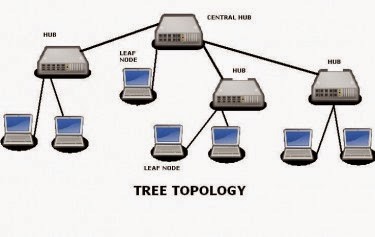
Tree topologies integrate multiple star topologies together onto a bus. In its simplest form, only hub devices connect directly to the tree bus, and each hub functions as the root of a tree of devices. This bus/star hybrid approach supports future expandability of the network much better than a bus (limited in the number of devices due to the broadcast traffic it generates) or a star (limited by the number of hub connection points) alone.

Celebrity Authors’ Secrets - The World’s Greatest Living Authors Reveal How They Sell Millions of Books by Stephanie Hale. $12.99 from Smashwords.com

Twelve of the world's greatest living authors reveal their tips for writing a book that sells over a million copies in Celebrity Authors' Secrets. A must-have guide - filled with publishing and book marketing info - for aspiring writers, authors, publishers, editors, writing coaches, creative writing tutors and anyone who loves books. Find out how to make your book stand out from the masses!

This topology divides the network in to multiple levels/layers of network. Mainly in LANs, a network is bifurcated into three types of network devices. The lowest most is access-layer where user’s computer are attached. The middle layer is known as distribution layer, which works as mediator between upper layer and lower layer. The highest most layer is known as Core layer, and is central point of the network, i.e. root of the tree from which all nodes fork.


How to Create a Trade Mark, Protect it and Build your Brand by Liam M Birkett. $9.99 from Smashwords.com
You will learn how to devise your trade mark The essential steps to ensure that you can use the mark How to register and protect it How to exploit multiple types of trade marks The misconceptions regarding company names Errors relating to domain names How to use your branding to get free publicity How to add value to your brand A strategy to follow for expansion Practical examples of trade marks


Computer Network : Star Network Topology

All hosts in star topology are connected to a central device, known as Hub device, using a point-to-point connection. That is, there exists a point to point connection between hosts and Hub. 
Many home networks use the star topology. A star network features a central connection point called a "hub node". 
Devices typically connect to the hub with Unshielded Twisted Pair (UTP) Ethernet.
Compared to the bus topology, a star network generally requires more cable, but a failure in any star network cable will only take down one computer's network access and not the entire LAN. (If the hub fails, however, the entire network also fails.)


Computer Network : Ring Network Topology

In a ring network, every device has exactly two neighbors for communication purposes. All messages travel through a ring in the same direction (either "clockwise" or "counterclockwise"). A failure in any cable or device breaks the loop and can take down the entire network.  
Local-area network (LAN) topology is a ring. All of the nodes are connected in a closed loop. Messages travel around the ring, with each node reading those messages addressed to it. One main advantage to a ring network is that it can span larger distances than other types of networks, such as bus networks, because each node regenerates messages as they pass through it. Ring topologies are found in some office buildings or school campuses.

Computer Network : Bus Network Topology

A computer network topology is the physical communication scheme used by connected devices. 

Bus Topology is a very simple network topology. All the nodes are connected to the single cable called bus, by the help of interface connectors. This central cable is the backbone of the network and is known as Bus Every workstation communicates with the other device through this Bus. 
It is easy to set-up and extend bus network. Bus topology costs very less. Linear Bus network is mostly used in small networks and it is useful for LAN.
There is a limit on central cable length and number of nodes that can be connected. There is always a Dependency on central cable in this topology. If the main cable (i.e. bus ) encounters any problem, whole network breaks down. This network topology is not suitable for networks with heavy traffic. And Security is very low because all the computers receive the sent signal from the source.