Showing posts with label Media. Show all posts

Communication Media : Satellite

The problem with microwave communications is of line of sight. Because of the curvature of earth, mountains and other high structures often block the line of sight. So you require several repeater stations for long-distance transmission, which increases the cost of data transmission. This problem is overcome by using satellites.
A communication satellite is an electrical device positioned in an orbit around the earth. It can be thought of a big microwave repeater in the sky. I contains one or more 'transponders', each of which listens to some portion of the frequency spectrum, amplifies the incoming signal and then rebroadcasts it at another frequency. Different frequencies are used for 'uplinking' and 'downlinking' to avoid any interference of signals. Uplink refers to data flow from the earth to the satellite. Here the earth station works as a transmiter and the satellite transponder as a receiver. Downlink refers to data flow from the satellite to the earth. Here the saellite works as a transmitter and the earth station as a receiver.

Advantages
There is no line of sight restriction, so transmission and reception is possible between any two randomly chosen places.
Disadvantages
Launching a satellite into an orbit costs a lot.
A signal sent to a satellite is broadcasted to all receivers within the satellite's range. So, measures are required to prevent unauthorized tampering of information.

Communication Media : Microwave Link

Microwave radiation is also a popular medium of transmission. It does not require the laying of expensive cables. Microwave links use  very high frequency radio waves to transmit data through space. Microwave links use repeaters at intervals of about 25 to 30 km in between the transmitting and receiving stations

Parabolic antennas are mounted on towers to send a beam to another antenna which could be tens of kilometers away, but should be in the line of sight. The higher the tower the greater is the range. Microwave radio transmission is widely used for long-distance communication. It overcomes the problem of weak signals.

Advantages
  • Building two towers is cheaper than digging a 100 km trench and laying cables in it.
  • It can permit transmission rates of about 16 giga (1 giga bit = 10 to the power of 9 bits) bits per second.
Disadvantages
  • Repeaters, if used along the way, are to be maintained regularly.
  • Physical vibration will show up as signal noise.

Celebrity Authors’ Secrets - The World’s Greatest Living Authors Reveal How They Sell Millions of Books by Stephanie Hale. $12.99 from Smashwords.com
Twelve of the world's greatest living authors reveal their tips for writing a book that sells over a million copies in Celebrity Authors' Secrets. A must-have guide - filled with publishing and book marketing info - for aspiring writers, authors, publishers, editors, writing coaches, creative writing tutors and anyone who loves books. Find out how to make your book stand out from the masses!

Communication Media : Radio Frequency Propagation


Data transmission through air (and not through any channel) is called unguided transmission. Data is carried over electro-magnetic radiation in the form of radio waves. Such propagation is classified by the type of wave used for propagation. There are three types of RF (radio frequency) propagation.
  1. Ground wave
  2. Ionospheric
  3. Line of Sight (LOS)
Ground Wave Propagation
Ground wave propagation follows the curvature of the earth. Ground waves have carrier frequencies up to 2 MHz. The AM radio is an example of ground wave propagaiton.
Ionospheric Propagation
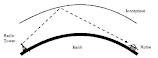
Ionospheric propagation bounces off the Earh's ionspheric layer in the upper atmosphere. It is sometimes called double hop propagation. It operates in the frequency range of 30 - 85 MHz. Because it depends on the Earth's ionosphere, it changes with the weaher and the time of the day. The signal sent from a radio tower bounces off the ionosphere and comes back to earth to a receiving station.

Line of Sight Propagation
Line of sight propagation transmits exactly in the line of sight. The receiving station must be in the view of the transmit station. It is someimes called space wave or tropospheric propagation. It is limited by the curvature of the Eartth for ground-based stations (100 km. from horizon to horizon). Reflected waves can cause problems. Examples of line of sight propagation are FM radio, and satellite microwave.

Communication Media : Coaxial Cable

Coaxial Cables are a group of specially wrapped and insulated wires capable of transmiting data at a very high rate. They consist of a central copper wire (inner conductor) surrounded by a PVC (polyvinyl chloride) insulation over which a sleeve of copper mesh (second conductor) is covered.

The metal sleeve is again shielded by an outer shield of thick PVC material. The signal is transmitted by the inner copper wire and is electrically shielded by the outer metal sleeve. Coaxial cables are extensively used in long-distance telephone lines and in closed-circuit TV.


Advantages
  • They are capable of transmitting digital signals at a very high rate of approximately 10 mega bits per second.
  • They have a higher noise immunity.
Disadvantages
  • These are compariively costly.
  • Such cables can easily be tapped, posing security problems.

Communication Media : Twisted Pair Cable

A twisted cable is the oldest and most common medium of transmission. It is generally used in telephone systems. A twisted pair consists of two insulated copper wires, typically 1 mm thick, twisted together just like a DNA molecule. The wire is twisted so as to reduce the electrical interference from and to the adjacent copper pairs. (The two conducting wires, which run parallel to each other, may cause electrical interference.)
When many twisted pairs run in parallel over a long distance, they are bundled togeher and enclosed in a proective sheath, so as not to interfere with each other. twisted pair is also used in a LAN (Local Area Network)

Advantages
It can be used for analog as well as digital transmission.
It is one of the cheapest media of transmission and has adequate performance.
Disadvantages
It is more prone to pick up noise signals.
A twisted pair can transmit dara only upto a certain distance.