Showing posts with label Networking. Show all posts

Computer Network : Mesh Network Topology

Mesh topologies involve the concept of routes. Unlike each of the previous topologies, messages sent on a mesh network can take any of several possible paths from source to destination. (Recall that even in a ring, although two cable paths exist, messages can only travel in one direction.) Some WANs, most notably the Internet, employ mesh routing.
A mesh network in which every device connects to every other is called a full mesh. 
The mesh network topology employs either of two schemes, called full mesh and partial mesh. In the full mesh topology, each workstation is connected directly to each of the others. In the partial mesh topology, some workstations are connected to all the others, and some are connected only to those other nodes with which they exchange the most data.

Slow Up by George Saoulidis. $8.99 from Smashwords.com
How Fast Can You Think? Limitless meets Black Mirror in this novel that pushes the limits of a couple's minds.


Computer Network : Tree Network Topology

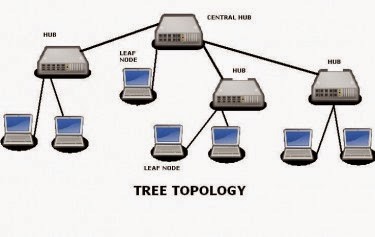
Tree topologies integrate multiple star topologies together onto a bus. In its simplest form, only hub devices connect directly to the tree bus, and each hub functions as the root of a tree of devices. This bus/star hybrid approach supports future expandability of the network much better than a bus (limited in the number of devices due to the broadcast traffic it generates) or a star (limited by the number of hub connection points) alone.

Celebrity Authors’ Secrets - The World’s Greatest Living Authors Reveal How They Sell Millions of Books by Stephanie Hale. $12.99 from Smashwords.com

Twelve of the world's greatest living authors reveal their tips for writing a book that sells over a million copies in Celebrity Authors' Secrets. A must-have guide - filled with publishing and book marketing info - for aspiring writers, authors, publishers, editors, writing coaches, creative writing tutors and anyone who loves books. Find out how to make your book stand out from the masses!

This topology divides the network in to multiple levels/layers of network. Mainly in LANs, a network is bifurcated into three types of network devices. The lowest most is access-layer where user’s computer are attached. The middle layer is known as distribution layer, which works as mediator between upper layer and lower layer. The highest most layer is known as Core layer, and is central point of the network, i.e. root of the tree from which all nodes fork.


How to Create a Trade Mark, Protect it and Build your Brand by Liam M Birkett. $9.99 from Smashwords.com
You will learn how to devise your trade mark The essential steps to ensure that you can use the mark How to register and protect it How to exploit multiple types of trade marks The misconceptions regarding company names Errors relating to domain names How to use your branding to get free publicity How to add value to your brand A strategy to follow for expansion Practical examples of trade marks


Computer Network : Star Network Topology

All hosts in star topology are connected to a central device, known as Hub device, using a point-to-point connection. That is, there exists a point to point connection between hosts and Hub. 
Many home networks use the star topology. A star network features a central connection point called a "hub node". 
Devices typically connect to the hub with Unshielded Twisted Pair (UTP) Ethernet.
Compared to the bus topology, a star network generally requires more cable, but a failure in any star network cable will only take down one computer's network access and not the entire LAN. (If the hub fails, however, the entire network also fails.)


Computer Network : Ring Network Topology

In a ring network, every device has exactly two neighbors for communication purposes. All messages travel through a ring in the same direction (either "clockwise" or "counterclockwise"). A failure in any cable or device breaks the loop and can take down the entire network.  
Local-area network (LAN) topology is a ring. All of the nodes are connected in a closed loop. Messages travel around the ring, with each node reading those messages addressed to it. One main advantage to a ring network is that it can span larger distances than other types of networks, such as bus networks, because each node regenerates messages as they pass through it. Ring topologies are found in some office buildings or school campuses.

Computer Network : Bus Network Topology

A computer network topology is the physical communication scheme used by connected devices. 

Bus Topology is a very simple network topology. All the nodes are connected to the single cable called bus, by the help of interface connectors. This central cable is the backbone of the network and is known as Bus Every workstation communicates with the other device through this Bus. 
It is easy to set-up and extend bus network. Bus topology costs very less. Linear Bus network is mostly used in small networks and it is useful for LAN.
There is a limit on central cable length and number of nodes that can be connected. There is always a Dependency on central cable in this topology. If the main cable (i.e. bus ) encounters any problem, whole network breaks down. This network topology is not suitable for networks with heavy traffic. And Security is very low because all the computers receive the sent signal from the source.

Computer Networks

Network can be classified into 3 major types depending upon the geographic spread. They are:
1. LAN (Local Area Network)
2. MAN (Metropolitan Area Network)
3. WAN (Wide Area Network)

LAN
A LAN or a Local Area Network is a network that is restricted to a small physical area. A small LAN might connect a few computers in an office or in a home; a large LAN could extend over an office park or university campus, connecting computers and other devices in a number of buildings. The major benefit of a local area network is that it can help to reduce cost by allowing people and microcomputers to share expensive resources.
There are three types of LANs. They are discussed below:
1. Dedicated Server LANs: Dedicated server LANs account for more than 70 percent of all installed LANs. A dedicated server LAN can connect with almost any other network, can handle very large databases and have a dedicated nework server.
2. Peer-to-Peer LANs: This network is a local area network that allows all users access to data on all workstations. In such networks, any computer on the network shares its resource such as hard disk and printer with any other computer on the same network.
3. Zero-slot LANs: This LAN operates like peer to peer LAN, but offers limited simple abilities such as sharing files and printers, transfer of files and transmission of e-mail. It is inexpensive. It does not require a network interface circuit card. Its adapter plug can be plugged into a serial or parallel port. This network usually can handle up to 30 computers

MAN
This is larger than a LAN and stands for Metropolitan Area Network. A MAN usually spans a geographical area that encompasses a city or country area. It interconnects various buildings or other facilities within this area. For example, linkages can be established between two commercial buildings. MAN technology has been rapidly developing in the area of cellular phone systems.

WAN
A wide area network (WAN) is one that operates over a vast distance (e.g., nationwide). Its nodes may span cities, states, or national boundaries. This network interconnects computers, LANs, MANs and other data transmission facilities. A WAN will employ communications circuits such as long distance telephone wires, microwaves, and satellites. Nationwide automated teller machines used in banking represent a common application of a wide area network.

Networking

Networking is the form of computer communication generally used for exchanging data and information. Two or more computers are connected together or networked by some types of communication media (wire or cable) to form a data path as to exchange program and data files between them.
Networking allows accessing shared output devices and data storage connected to the network. Examples of shard devices are printers, plotters and hard disks.

Need
Networking satisfies a broad range of purposes and meets various requirements. Networking has become essential for the following reasons:
1. File sharing
2. Resource sharing
3. Unlike equipment and communication.
4. To improve speed and accuracy.
5. Low cost.
6. For instant availability of data.
File Sharing
Networking enables a user to share files between all the connected computers. For example, the users of an organization having its different offices at distant places in a city, which are physically separated but are connected on a network, can share their files and data without moving physically to each and every office.
Resource Sharing
Laser printers and hard disks can be expensive. Networking enables users to share such resources by networking several computers together. For example, a company with say 20 users, each requiring only limited hard disk space and occasional printing, might save money by purchasing fewer resources and sharing them.
Unlike Equipment Communication
Through networking it is also possible to share and send messages between computers having equipment of different brands and using different operating systems like DOS, UNIX, MacOS, etc.
Improve Speed and Accuracy
Sending messages through a network is instantaneous as compared to a common letter, which takes several days to deliver. Computers can send data at very fast speed through satellite or microwave links. Also there are less chances of data being lost in case of networking. Accuracy is also maintained here.
Low Cost.
The cost of ttransferring data between computers connected on a network is lower than by other conventional means of transferring documents.
Instant Availability
Since the time taken in transferring data is quite small, data is available instantlyy at the other end. This feature is useful for communication price fluctuations in foreign exchange and in share/equity trading etc.